StikineRiverBooks


Books by author Bonnie Demerjian
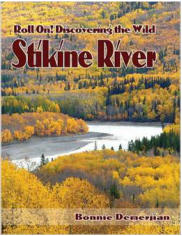
Roll On! Discovering The Wild Stikine
River
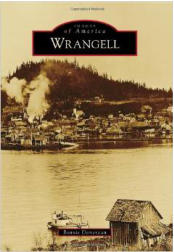
Petroglyphs of undetermined age dot the tide line along a sandy beach. Ancient spirals, fish forms and staring eyes pecked into wave-smoothed boulders look northward across the water to the broad sandy delta of the Stikine River. These rock carvings are mute testimony to the enduring attraction of an immense watercourse that drains a land overflowing with history and natural beauty. The Stikine River empties into the salt water of Southeast Alaska’s panhandle, a strip of American soil ten to 150 miles in width that stretches over five hundred miles north from Ketchikan. The river rises in the interior highlands of northern British Columbia and journeys nearly four hundred untamed miles before spilling into the ocean near the island community of Wrangell. The greater part of this transboundary river, billed as the fastest free-flowing navigable river in North America, lies in Canada. Its final thirty-odd miles traverse United States territory Anan: Stream of Living Water What could be simpler than a wooded stream rippling through an unassuming valley? True, it attracts bears, brown and black, with an abundance of salmon. Other creatures, too, gravitate to its waters and banks to feast on the leavings of bears, decayed carcasses of spawned-out fish. Humans are among those attracted to the stream, Native people from past millennia and today’s visitors. The creek is located on the northern shore of the Cleveland Peninsula, an arm of the Southeast Alaska’s mainland, positioned south of Wrangell and north of Ketchikan. Anan’s story begins with a clash of titans as tectonic movement led the North American and Pacific plates, slowly but inexorably over 500 million years, in a grinding, elephantine dance. Blocks of the earth’s crust, some originating at the equator or further, moved northward and east. Wrangell Wrangell is named after Baron Ferdinand von Wrangell of the Russian American Company. He was charged with extending Russia’s fur trade into Southeast Alaska. To that end, he ordered a fort to be established in 1833 on Wrangell Island near the mouth of the Stikine River. The Stikine Tlingit Indians, who were scattered in villages nearby, moved closer to take advantage of fur trading opportunities. In 1839 the fort passed into the hands of the British Hudson’s Bay Company. With the purchase of Alaska in 1867, the need was urgent to enforce the United States’ presence in its recently acquired territory. An American fort was built which the US Army occupied during a series of gold rushes, ending with the Klondike Rush in 1898. Wrangell began to grow beyond its boom-and-bust origins during the 20th century, becoming a thriving hub for lumber, fishing and mining as we as for the newly minted tourist industry. A rich and varied selection of archival photographs documents the history of this robust Alaskan town. This book is part of the Images of America series published by Arcadia Publishing that celebrates the history of neighborhoods, towns and cities across the country.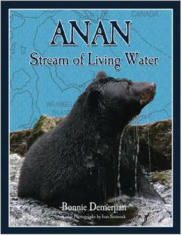
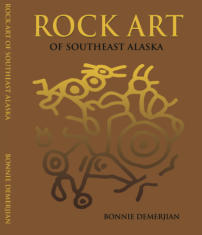
Rock Art of Southeast Alaska
Petroglyphs and pictographs, rock carvings and rock paintings, are found on all continents.
Southeast Alaska, however, is home to some of the world’s most fascinating and accessible
rock art. Who made it? When, how and why? Answers to these questions are tangled with the
puzzle of who, when and how the New World was populated during and following the most
recent ice age, a puzzle whose pieces are being accumulated at a growing rate. Take a step
backward to learn more about the culture of early peoples of Southeast Alaska and their
forebears and learn how their deep sense of place was imprinted by means of clan symbols in
rock and paint. Discover more about the shamans who helped them navigate their world and
who left an enduring record of the spirits who populated it.
US Purchase
$24.99 USD
plus
$5.75 U.S. shipping
Outside US
US Purchase
$14.95USD
plus
$5.75 U.S. shipping
Outside US
US Purchase
$21.99 USD
plus
$5.75 U.S. shipping
Outside US
US Purchase
$19.99 USD
plus
$5.75 U.S. shipping
Outside US
© Stikine River Books - P.O. Box 1762 - Wrangell, Alaska 99929 - 907.874.3665







"...Bonnie Demerjian gives the reader an amazingly comprehensive look at a river whose colorful history is as appealing as its wilderness shores. Demerjian's use of language
brings out her passion for the Stikine, and through words and images the reader comes to experience the rich and vivid tapestry of the place..."
Roll On! Discovering The Wild Stikine River - Alaska History Review by Kaylene Johnson, Wasilla, Alaska